
Schoolhouse Educational Services Webinars For Special Education Professional Training
Schoolhouse Educational Services, is now a NASP-Approved Provider!
Schoolhouse Educational Services Inc. is approved by the National Association of School Psychologists (NASP) to offer continuing professional development for school psychologists. Under the guidance of Dr. Milton J. Dehn, we will be adding NASP-approved courses to meet the continuing education and professional development needs of school psychologists. Schoolhouse Educational Services, Inc. maintains responsibility for the professional development programs that it offers.
NASP CPD Approved Professional Training
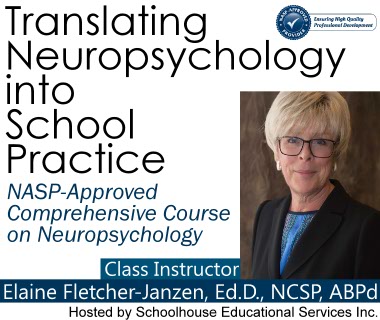
Translating Neuropsychology into School Practice
24 NASP CPD Hours Available
Hosted by Schoolhouse Educational Services, Inc.
This program is designed for educational personnel from multiple disciplines such as regular and special education teachers, intervention specialists, school psychologists, educational diagnosticians, speech language pathologists, occupational therapists, counselors, social workers, support personnel, IEP team members, and school administrators.
Memory Intervention Certificate Program
Format: Recorded Class, Consultation, and Supervised Case
Hosted By: School Neuropsychology Institute
Instructor: Dr. Milton Dehn
The Memory Intervention Certificate Program is 36-hour webinar-based program designed to train psychologists and school psychologists in neuropsychological and evidence-based methods in assessment and intervention to improve memory, learning, and daily functioning in youth and adults with memory impairments and memory problems.
The CEU’s are both NASP and APA approved, and they are also approved by California and New York.
The link below leads to the School Neuropsychology Institute website.
END OF NASP-CPD Approved Webinars & Training
Live Webinars – NASP CPD Approved
Stay Tuned For Winter 2026-2027 LIVE Webinar and Training Schedule
On Demand Webinars – NASP CPD Approved
Ethics, Cultural Neuropsychology, and Practical Outcomes in Assessment and Practice
Meets Ethics Continuing Education Requirements
3-hour On-Demand webinar with NASP CPDs available
Description
This workshop integrates ethical standards, cultural neuropsychology, and applied practice to support more accurate, equitable, and meaningful assessment in clinical and educational settings. Grounded in professional ethics, participants will examine how bias can emerge in test construction, administration, and interpretation and how culturally responsive practices can mitigate these risks.
The session also explores how brain development unfolds through the interaction of universal neurobiology and culturally mediated experience, including the influence of language, socioeconomic context, stress exposure, and educational opportunity on neural systems and cognitive performance. Participants will also consider the limitations of current neuroscience research, particularly the overrepresentation of Western samples, and the implications for generalizability and equity in practice.
Emphasis is placed on translating this knowledge into practical outcomes: selecting and evaluating assessment tools, integrating multiple data sources, interpreting results within context, and using assessment to understand the whole child rather than relying on isolated scores. Through applied examples and reflective exercises, participants will develop a framework for culturally responsive, ethically grounded decision-making that improves both interpretation and intervention.
Instructor
Elaine Fletcher-Janzen, Ed.D., NCSP, ABPdN, obtained her doctorate in School Psychology from the College of William and Mary in 1993, and has been a school psychologist in the public schools, neuropsychiatric inpatient, and university settings for the past 40 years. Dr. Fletcher-Janzen received her Diplomate in Pediatric Neuropsychology in 2010. She has been a Professor of School Psychology, a Past President of the American Academy of Pediatric Neuropsychology and has received the Lifetime Achievement Award from the School Neuropsychology Institute.
Format: Recorded Webinar
Recorded : June 2026
Cost: $120
Learning Objectives:
At the conclusion of the training attendees will be able to:
- Explain key ethical standards related to culturally responsive neuropsychological practice, including considerations in test construction and interpretation.
- Define cultural neuropsychology and describe how culture and lived experience shape brain development and cognitive processes.
- Identify how factors such as language, socioeconomic status, and stress exposure influence neurodevelopment and assessment outcomes.
The Anxious Brain: How Anxiety Impact Learning and Behavior
90-minute On-Demand webinar with NASP CPDs Available
Description: Anxiety disorders are the most common type of mental health disorder in youth, with prevalence rates estimated between 5-10% of young people. There is a developmental nature in how pediatric anxiety disorders are expressed, with very young children often demonstrating separation anxiety. In contrast, adolescents struggle with both social anxiety as well as generalized anxiety. Nevertheless, the essential features of almost all pediatric anxiety disorders are avoidant behavior and catastrophic thinking, both of which can hinder academic functioning. Therefore, this webinar will discuss how anxiety impact academic performance and behavior from a brain-based educational perspective. There will be a discussion highlighting the physiological, cognitive, and behavioral manifestations of anxiety, as well as several evidence-based interventions and strategies. Lastly, specific assessment and screening measures will be featured, including the new Student Anxiety Rating Scales (STARS).
Instructors:
Steven G. Feifer, D.Ed., ABPdN
Scott T. Winget, Psy.D., ABSNP
Format: Recorded Webinar
Recorded: August 2025
Cost: $60
Learning Objectives:
At the conclusion of the training attendees will be able to:
- Identify key brain regions associated with anxiety and be able to distinguish “bottom-up” vs. “top-down” types of anxiety conditions.
- Describe how anxiety impacts reading, writing, and mathematics, and how to differentiate learning disabilities from poor school performance due to anxiety.
- Recognize how the Student Anxiety Rating Scale assesses the nature and severity of school-based anxiety..
The Woodcock-Johnson V Tests of Cognitive Abilities: Administration, Scoring, and Interpretation
5-hour On-Demand webinar with NASP CPDs available
Description:
The new Woodcock-Johnson V Tests of Cognitive Abilities is a comprehensive battery composed of 20 tests based on the most recent version of Cattell-Horn-Carroll (CHC) theory. In this virtual training workshop Dr. Dehn will cover selective testing, administration, scoring, and interpretation, as well as the theoretical basis of the WJ V Cognitive and the changes that have been made.
Instructor:
Milton J. Dehn, Ed.D.
Format: Recorded Webinar
Recorded: August 2025
Cost: $175
Using the Woodcock-Johnson V Tests of Achievement to Evaluate Academic Achievement and Learning Problems
6-hour On-Demand webinar with NASP CPDs available
Description:
The new Woodcock-Johnson V Tests of Achievement is a comprehensive battery composed of 26 tests that cover everything needed to assess every area of academic achievement. In this virtual training workshop Dr. Dehn will cover selective testing, administration, scoring, and interpretation, as well as the changes that have been made and how to use the new digital format and options. There will also be an emphasis on how to identify specific learning disabilities using this new scale.
Instructor:
Milton J. Dehn, Ed.D., is the Test Development Project Director for Schoolhouse Educational Services. He practiced School Psychology in schools and in private practice for more than 35 years. He was also a School Psychology professor and program director for 13 years at the University of Wisconsin-La Crosse where he taught assessment courses. Dr. Dehn is an author and speaker on cognitive assessment, SLD identification, PSW, dyslexia, executive functions, social-emotional learning, and children’s memory problems.
Format: Recorded Webinar
Recorded: July 2026
Cost: $175
CE Credits: 6 CEUs or NASP CPD hours available
Learning Objectives:
At the conclusion of the training attendees will be able to:
- Select appropriate Woodcock-Johnson V Clusters and Tests that match the referral concerns and the purpose of the assessment.
- Describe how to use the WJ V digital platform and how to administer the WJ V digital Tests.
- Recognize the changes that have been made to the WJ Tests of Achievement.
- List many of the important administration and scoring procedures to follow when administering the WJ V Tests of Achievement.
- Appropriately interpret an examinee’s WJ V test results.
Dyslexia Assessment Options: Selecting Tests That Address Referral Concerns
90-minute On-Demand Webinar with NASP CPDs Available
Description:
With increasing demand for dyslexia evaluations, more cognitive and achievement tests designed to assess dyslexia have recently been published. This webinar will begin by identifying dyslexia characteristics and the most important cognitive processes that are necessary for the development of reading skills. The focus of the webinar will be a review of established and recently released measures designed for dyslexia assessment. The available options and benefits of these scales will be compared. The most appropriate selections may depend on the examinee’s age, background, severity of the reading delays, and cognitive strengths and weaknesses.
Instructor:
Milton J. Dehn, Ed.D.
Format: Recorded Webinar
Recorded: July 2025
Cost: $45
Learning Objectives:
At the conclusion of the training attendees will be able to:
- Identify the key cognitive processes that are necessary for the development of reading skills.
- Identify a few different dyslexia assessment scales and describe how they compare with each other.
- Select an appropriate dyslexia assessment battery from multiple measures when given the age and referral concerns for a child being evaluated for dyslexia.
Using the IEP/504 Process to Address Student Behavioral Needs & Well Being
2-Hour On-Demand webinar with NASP CPDs available
Description:
One of our greatest professional challenges is to provide educational opportunities and behavioral health support for all students in a safe and welcoming environment. This presentation will help rethink how we can most efficiently and effectively use the IEP/504 Process to address challenging behaviors to build a program around the student and not just fit them into one. Discipline, like instruction, can be an opportunity to teach new skills and replacement behaviors by moving upstream. Dr. Hartwig will walk through a Ten step process to support students by matching the most powerful and meaningful interventions to student needs in real time.
Instructor:
Eric P. Hartwig, Ph.D., a frequent and engaging speaker, has worked as a Director of Pupil Services, a District Administrator and a School Psychologist. He is the lead consultant on a Behavioral Health Project with Marshfield Clinic, and he is the author and principle trainer on the Just-in-Time: Behavioral Health Initiative. Dr. Hartwig is also the creator of the online universal screener for behavioral, emotional and social traits (b.e.s.t.).
Format: Recorded Webinar
Recorded: January 2025
Cost: $75
Learning Objectives:
At the conclusion of the webinar attendees will be able to:
- Participants will describe a stepwise approach to assessment that uses the IEP/504 process to support Behavioral Health practices.
- Participants will identify the ten most important steps to follow for matching interventions and supporting student needs.
- Participants will describe how to balance the IEP/504 process with safety, accountability, and skill building.
Using the Tests of Dyslexia to Diagnose Dyslexia and Reading Disorders
New 4-Hour On-Demand webinar with NASP CPDs available
Description:
The recently released Tests of Dyslexia (TOD), by Nancy Mather and others, is a very comprehensive battery of individually administered tests of academic skills and cognitive aptitudes that is intended to eliminate the need for cross-battery testing when conducting assessments of students struggling with reading. Dr. Dehn will cover the administration, scoring, and interpretation of the TOD. The focus will be on effective use and interpretation of the TOD when conducting dyslexia and reading disability assessments. An in-depth case study will be included.
Instructor:
Milton J. Dehn, Ed.D., is the Test Development Project Director for Schoolhouse Educational Services. He practiced School Psychology in schools and in private practice for more than 35 years. He was also a School Psychology professor and program director for 13 years at the University of Wisconsin-La Crosse, where he taught assessment courses. Dr. Dehn is an author and speaker on cognitive assessment, SLD identification, PSW, dyslexia, executive functions, social-emotional learning, and children’s memory problems.
Format: Recorded Webinar
Recorded: January 2025
Cost: $149
Learning Objectives:
At the conclusion of the webinar attendees will be able to:
- Select appropriate TOD tests and components that match the referral concerns and the purpose of the assessment.
- Identify the linguistic and cognitive processes that are necessary for the development of reading skills.
- Appropriately interpret an examinee’s strengths and weaknesses on TOD tests.
- Describe the TOD’s general administration and scoring procedures.
Using the Feifer Assessment of Math to Diagnose Math Disorders
3-Hour On-Demand Training Webinar with NASP CPDs available
Instructor: Milton J. Dehn, Ed.D.
Dr. Dehn is the Test Development Project Director for Schoolhouse Educational Services. Dr. Dehn practiced School Psychology in schools and in private practice for more than 35 years. He was also a School Psychology professor and program director for 13 years at the University of Wisconsin-La Crosse. Dr. Dehn is an author and speaker on cognitive assessment, Specific Learning Disorders (SLD) identification, Patterns of Strengths and Weaknesses (PSW), dyslexia, executive functions , social-emotional learning (SEL), and children’s memory problems.
Description:
The Feifer Assessment of Math (FAM) is a unique test that includes both math skills and math aptitudes. It is ideal for diagnosing math learning disabilities and dyscalculia. After providing background on the development of math skills and the characteristics of math disorders, this workshop will cover the use, administration, scoring, and interpretation of the FAM. The focus will be on effective use and interpretation of the FAM when conducting dyscalculia and mathematics disability assessments.
Format: Recorded Webinar
Recorded: October 2024
Cost: $149
Learning Objectives:
At the conclusion of the webinar attendees will be able to:
- Identify the primary cognitive aptitudes associated with the development of mathematics reasoning and skills.
- Identify the primary characteristics of dyscalculia.
- Describe how to interpret the FAM’s composite scores.
- Use a selective testing approach when deciding which FAM subtests to administer.
An Update on PSW and the PPA
90-Minute On-Demand Webinar with NASP CPDs available
Instructor: Milton J. Dehn, Ed.D.
Dr. Dehn is the Test Development Project Director for Schoolhouse Educational Services. Dr. Dehn practiced School Psychology in schools and in private practice for more than 35 years. He was also a School Psychology professor and program director for 13 years at the University of Wisconsin-La Crosse. Dr. Dehn is an author and speaker on cognitive assessment, Specific Learning Disorders (SLD) identification, Patterns of Strengths and Weaknesses (PSW), dyslexia, executive functions , social-emotional learning (SEL), and children’s memory problems.
Description: The Pattern of Strengths and Weakness approach to Specific Learning Disorder identification is growing in popularity across the U.S. This session will discuss what PSW models have in common and also discuss the latest trends in using PSW. This will be followed by an overview of Dehn’s comprehensive PSW model and an overview of Dehn’s analytical PSW software, the Psychological Processing Analyzer (PPA), and recent changes to it.
Format: Recorded Webinar
Recorded: October 2025
Cost: $39
Learning Objectives:
At the conclusion of the webinar attendees will be able to:
- Identify general PSW criteria used to identify SLD.
- Describe the latest trends in PSW.
- Recognize when a case study meets PSW criteria.
- Recognize some of the unique features of Dehn’s model and software.
Featured On-Demand Webinars For Special Education Professionals
Please allow 24 hours after an on-demand webinar purchase for an email with the handouts and access link.
Using the Feifer Assessment of Writing to Diagnose Written Language Disorders
Presenter: Dr. Milton J. Dehn
Recorded: February 2024
Format: Recorded Webinar
Price: $149
The FAW is a unique test that includes both writing skills and writing aptitudes. It is ideal for diagnosing dysgraphia and written language disorders. This three-hour workshop will cover the administration, scoring, and interpretation of the FAW. The focus will be on effective use and interpretation of the FAW when conducting dysgraphia and written expression disability assessments
Administration, Scoring and Interpretation of the Woodcock-Johnson IV Tests of Achievement & Woodcock-Johnson IV Tests of Oral Language
Presenter: Dr. Milton Dehn
Format: Recorded Webinar
Price: $195.00
This 6-hour (on demand) webinar includes an overview of the two scales, how to do selective testing for various disabilities, general administration and scoring rules, specific administration scoring rules for the tests/subtests, how to use the online scoring, and how to interpret the results on the score report.
Overview of Speech Production: Assessment and Diagnosis
Presenter: Dr. Stephen Camarata
Format: Recorded Webinar
Price: $45.00
This recorded webinar by Dr. Stephen Camarata provides an overview of speech production and the assessment of speech and articulation. It also discusses speech development, why phonemes matter, why words matter, levels of assessment, and speech developmental norms. Finally, it introduces the Woodcock-Camarata Articulation Battery.
Effective Study Skills for Students with Specific Learning Disabilities
Presenter: Dr. Milton Dehn
Format: Recorded Webinar
Recorded: July 2023
Price: $99
Students with learning disabilities often lack good study skills and memorization strategies. Drawing on his 20 years of experience with tutoring and coaching students with SLD and students with memory problems, Dr. Dehn will present evidence-based procedures for study, memorization, and test taking that are effective with struggling and disabled students. During the workshop participants will have opportunities for practice with the methods, and they will be provided with written directions and handouts to take back to school this fall
Using the Feifer Assessment of Reading to Diagnose Reading Disorders
Presenter: Dr. Milton Dehn
Format: Recorded Webinar
Recorded: July 2023
Price: $149
The FAR is a unique test that includes both reading skills and reading aptitudes. It is ideal for diagnosing dyslexia and reading disabilities. This workshop will cover the administration, scoring, and interpretation of the FAR. The focus will be on effective use and interpretation of the FAR when conducting dyslexia and reading disability assessments.
Understanding the Role of Working Memory in Academic Learning
Presenter: Dr. Milton Dehn
Format: Recorded Webinar
Price: $45.00
This 90-minute recorded webinar discusses how working memory specifically influences all aspects of academic learning and academic performance, including its specific relations with reading, math, and written language skills. These relations are so strong that working memory deficits are likely to result in learning disabilities. Interventions for working memory are also reviewed, including cognitive load modifications, accommodations, working memory exercises, and teaching working memory strategies.
Using the WRAML-3 to Assess Children’s Memory
Format: Recorded Webinar
Recorded: May 2023
Price: $149.00
This webinar covers the administration, scoring, and interpretation of the WRAML-3 when conducting a comprehensive assessment of children’s memory. The focus is on interpretation of the Wide Range Assessment of Memory and Learning 3rd Edition using Dr. Dehn’s working and long-term memory assessment models.
This recorded webinar includes interesting discussion and questions and answers that occurred with attendees during the live presentation.
KTEA-3 Administration, Scoring, and Interpretation
Presenter: Dr. Milton Dehn
Format: Recorded Webinar
Price: $149.00
This 3-hour recorded training webinar teaches administration, scoring, and interpretation of the Kaufman Test of Educational Achievement (KTEA-3), with details on administration and scoring of the subtests and an emphasis on interpretation of results, especially regarding diagnosis of specific learning disabilities and dyslexia.
Comprehensive Assessment of Memory Using the Memory Processes Analyzer
Presenter: Dr. Milton Dehn
Format: Recorded Webinar
Price: $90.00
Working and long-term memory weaknesses in youth impair academic performance and achievement. An in-depth understanding of a learner’s memory strengths and weaknesses can lead to better student support and identification of learning disabilities. This 3-hour webinar will discuss 13 specific memory processes and their relations with academic learning.
Social Emotional Learning: Assessment and Intervention
Presenter: Dr. Milton Dehn
Format: Recorded Webinar
Price: $60.00
This 3-hour training workshop discusses the SEL construct, CASEL core competencies, relations between executive functions and SEL, recommended screening and assessment procedures, a new SEL rating scale, and SEL curriculum, training, and interventions options.
Early Identification of Dyslexia
Presenter: Dr. Milton Dehn
Format: Recorded Webinar
Price: $90.00
Updated: March 2023
This 3-hour webinar begins by discussing dyslexia definitions, characteristics, and misconceptions, followed by a detailed discussion of phonological and orthographic processing. The focus then shifts to the neuropsychology of dyslexia, followed by assessment strategies, including using a pattern of strengths and weaknesses approach, and examples of relatively new dyslexia-specific measures. This is followed by recommendations for screening and evaluating young children for dyslexia and an introduction to a recently released, norm-referenced screener. Case studies and interventions, especially for orthographic processing are included.
Administration, Scoring, and Interpretation of the Woodcock-Johnson IV Tests of Achievement
Presenter: Dr. Milton Dehn
Format: Recorded Webinar
Price: $195.00
The webinar includes an overview of the scale, how to do selective testing for various disabilities, general administration and scoring rules, specific administration scoring rules for the tests/subtests, how to use the online scoring, and how to interpret the results on the score report.
WIAT 4 Administration, Scoring, and Interpretation
Presenter: Dr. Milton Dehn
Format: Recorded Webinar
Price: $175.00
This 5.5 hour recorded training webinar teaches administration, scoring, and interpretation of the Wechsler Individual Achievement Test, Fourth Edition (WIAT 4), with details on administration and scoring of the subtests and an emphasis on interpretation of results, especially regarding diagnosis of specific learning disabilities and dyslexia.
Woodcock-Johnson IV Test of Cognitive Abilities
Presenter: Dr. Milton Dehn
Format: Recorded Webinar
Price: $175.00
This webinar-based workshop focuses on the administration, scoring, and interpretation of all of the tests in the Woodcock-Johnson IV Tests of Cognitive Abilities. The webinar also includes changes from the WJ III, an overview of the scale’s technical properties, the theoretical foundation of the WJ IV, how to do selective testing for various disabilities, a demonstration of online scoring, and interpretation of the results shown in the WJ IV score report.”
Using PSW to Identify Specific Learning Disabilities
Presenter: Dr. Milton Dehn
Format: Recorded Webinar
Price: $90.00
The focus of this workshop is on PSW assessment procedures, with an emphasis on Dehn’s PSW model. The webinar includes procedures for identifying statistically significant strengths and weaknesses when multi-battery test results need to be analyzed. Information about the Psychological Processing Analyzer (PPA) is also included. The workshop concludes with a brief review of evidence-based interventions for processing deficits.
Executive Functions in Children with ADHD
Presenter: Dr. Milton Dehn
Format: Recorded Webinar
Price: $45.00
This presentation discusses the executive functions that are most likely to be deficient or delayed in children with ADHD. Knowing these details will allow practitioners to better address the needs of children with ADHD.
An Introduction to Standardized Educational Testing
Presenter: Dr. Milton Dehn
Format: A 5.5-Hour On-Demand Pre-Recorded Training Webinar
Recorded: January 2023
Price: $149.00
Intended for new special education teachers who need to learn or review the fundamentals of individual, standardized testing of achievement and related areas. The webinar will cover the technical aspects of formal tests, such as reliability and validity. It will then help attendees understand test statistics and how to present standardized test scores to parents. Next, it will cover standardized administration and scoring procedures that apply to all tests. It will conclude with advice and models for interpreting test results in written reports.
Executive Functions Assessment and Intervention
Presenter: Dr. Milton Dehn
Format: Recorded Webinar
Price: $90.00
This recorded webinar proposes an in-depth, neuropsychological approach to executive functions assessment that goes beyond simple rating scales. The presentation includes a review of the new McCloskey Executive Functions Scale (MEFS). The webinar also includes information on evidence-based interventions that address specific executive weaknesses.
Please allow 24 hours after an on-demand webinar purchase for an email with the handouts and access link.
Free Webinars For Special Education Professionals
Improving Adolescent Mental Health Assessment in Schools
Free 90 Minute On-Demand Webinar
Description
The presenters will briefly review national youth mental health trends and how shifting referral patterns have expanded the school psychologist’s role beyond eligibility determination to early identification, intervention planning, and coordination with families and community providers. The core of the session addresses assessment best practices, including structured interviews, behavioral observation, record review, and standardized rating scales.
The session will also introduce a new multi-informant rating scale designed to improve adolescent mental health assessment. The MICAA is a research-validated, standardized assessment designed to provide a comprehensive picture of adolescent mental and emotional well-being. With 40 clinical scales and 26 school-specific scales, it helps practitioners identify risks and strengths in teens ages 12-18.
The MICAA’s assessment domains include:
- Internalizing symptoms (anxiety, depression, withdrawal)
- Externalizing symptoms (oppositionality, aggression, rule breaking)
- Attention & executive functioning
- Peer relationships & social behavior
- Academic engagement
- Daily functioning and routines
Presenters: Robert Basham, Ph.D., & Milton Dehn, Ed.D.
Format: On-Demand Webinar
Cost: Free
Explaining Learning Differences to Kids
New 90-minute On-Demand Webinar
Description:
Talking to kids about learning and developmental differences is tricky! Yet, if we do not have these conversations with our children, they tend to create their own narratives for why things are hard – and these narratives are often negative and isolating. As a result, too many children face anxiety and depression on top of their learning challenges. As psychologists, we are in a unique position to help kids change this narrative and their relationship to learning – for life.
In this workshop, you will learn a step-by-step approach to helping children develop an accurate and hopeful self-narrative, using empowering and personalized language to explain a diagnosis to the children you work with. This approach builds on research looking at how to talk to young people about their differences using collaborative, growth-mindset, and neurodiversity-affirming frameworks to show them the power of their amazing brains!
Instructor:
Liz Angoff, Ph.D., is a Licensed Educational Psychologist with a Diplomate in School Neuropsychology, providing assessment and consultation services to children and their families in the Bay Area, CA. She is the author of the Brain Building Books and Our Brains, empowering neurodivergent children to understand, celebrate, and advocate for their amazing brains. More information about Dr. Liz and her work is available at www.ExplainingBrains.com.
Format: On Demand Pre-Recorded Webinar
Recorded: February 2026
Cost: FREE
Access Password: GqT6%676
Learning Objectives:
By the end of this presentation, participants will be able to:
- Identify the steps for talking to kids about their unique profile in an empowering and neurodiversity-affirming way
- Create specific language to describe the common strengths and challenges of neurodivergent profiles in child-friendly language
- Create a personalized definition of a diagnosis for a specific child
Introducing the Student Anxiety Rating Scale (STARS)
Free 90 Minute Live Webinar
Description
Anxiety disorders are the most common type of mental health disorder in youth, with prevalence rates estimated between 5-10% of young people. There will be a discussion highlighting the physiological, cognitive, emotional, and behavioral manifestations of anxiety from a brain-based educational perspective. The webinar will also discuss how school-based social anxiety impacts school behavior and academic performance.
The session will also introduce the new Student Anxiety Rating Scales (STARS). The STARS is a standardized, norm-referenced multi-informant rating scale (parent, teacher, and self-report forms) that can be used to quantify the level of school-based social anxiety a student is experiencing. The STARS is designed to assess how student anxiety impacts learning and social-emotional behavior in a K-12 school-based environment. The STARS’s assessment domains include:
- Total Anxiety
- Performance
- Acceptance
- Emotional/Physical Distress
- Cognitive Distress
See more details on the STARS (Student Anxiety Rating Scale – STARS – Schoolhouse Educational Services, Inc.)
Presenters: Steven G. Feifer, D.Ed., & Scott Winget, Ph.D.
Format: Live Webinar
Schedule: 11:00 – 12:30 Central Time, Friday, September 11
Cost: Free
A Personal Journey to Equitable Assessment of Intelligence: Measure Thinking not Knowing
Presenter: Dr. Jack Naglieri
Format: On-Demand Pre-Recorded Webinar
Price: Free
Equitable intelligence testing has always been important, but in recent years the need for equity has become more urgent. This session will clarify what is meant by fair, equitable, and nonbiased assessment. Socially just assessment requires an understanding of the history intelligence tests, self-reflection on how we conceptualize and use these tests, and self-correction in response to the research. We can do better if we measure how well a student thinks (defined as PASS theory) in a way that is not confounded by what they know.
Assessment of Social-Emotional Learning from an Executive Functions Perspective
Presenter: Dr. George McCloskey
Format: On-Demand Pre-Recorded Webinar
Recorded: September 2023
Price: Free
As more schools focus on students’ social-emotional learning (SEL), screening and assessment of SEL is becoming a priority. Most schools adopt the CASEL model of SEL which addresses five broad and interrelated areas of competence: self-awareness, self-management, social awareness, relationship skills, and responsible decision-making. Dr. George McCloskey will discuss SEL assessment from an executive functions and CASEL perspective while introducing his new SEL rating scale.
Understanding Orthography: Reading and Spelling Do Involve the Eyes!
Presenter: Dr. Nancy Mather
Format: On-Demand Pre-Recorded Webinar
Recorded: January 2023
Price: Free
The purpose of this session is to explain how difficulties mastering English orthography impact both reading and spelling development. In the broadest sense, orthography refers to the components of the writing system of a language, including letters, numbers, punctuation marks, and spelling patterns and rules. Orthographic processing is how the brain acquires orthographic knowledge including forming, storing, and accurately and rapidly retrieving individual letters and spelling patterns. Participants will understand how orthographic knowledge is related to dyslexia and why it is so difficult for some children to acquire this knowledge.
The SEL Toolbox: Helping Students Generalize SEL Skills
Format: On-Demand Recorded Webinar
Price: Free
The SEL Toolbox provides practitioners intervention tools to help students generalize learned self-regulation and executive functioning skills. Students often have difficulty generalizing new, learned strategies outside of small, structured, group settings. This presentation offers a variety of creative, adaptable interventions that not only reinforce new self-regulation strategies, but also requires students to apply their skills in unpredictable, unstructured situations. When students practice self-regulation strategies in a safe environment that gradually becomes more challenging, they are more likely able to apply those strategies in a classroom setting.
Contextual Reasoning: The Overlooked Form of Reasoning in Diverse Populations
Free Webinar with Milton Dehn and Carl Romstad
Format: On-Demand Pre-Recorded Webinar
Recorded Live: May 2024
Price: Free
Description
The reasoning abilities of some diverse populations are often underestimated because of the traditional emphasis on abstract reasoning when assessing students who are struggling with academic learning. This presentation will explain contextual reasoning and the roles it plays in academic learning and daily life, followed by an introduction to a new standardized scale designed to measure contextual reasoning.
An In-Depth Approach to Processing Speed Assessment
Format: On-Demand Pre-Recorded Webinar
Recorded Live: August 2024
Price: Free
All cognitive processing depends on adequate neurological processing speed. Learn the details about processing speed development and functioning and why a more in-depth approach to its assessment is needed.
The Hippocampus: The Brain Center on which Learning Depends
Presenter: Dr. Milton Dehn
Format: On-Demand Pre-Recorded Webinar
Recorded Live: June 2024
Price: Free
Even a slight reduction in hippocampus functioning can have a significant impact on new learning and retention. Every educator, SLP, and psychologist should have an in-depth knowledge of this critically important brain structure and how to support it.
Assessment and Treatment of Student Stress
Presenter: Giorgio Jovani di Salvatore
Format: On-Demand Pre-Recorded Webinar
Price: Free
This presentation begins with a review of the impact of stress and trauma on academic achievement and cognitive processes, followed by a review of the neuropsychology and common symptoms of student stress and trauma. A new standardized rating scale for ages 5-18, the Comprehensive Assessment of Student Stress (CASS), is introduced, along with data illustrating how stress and trauma vary by demographic variables, such as ethnicity. The CASS is a digital tool that measures four areas of stress response: affective, behavioral, cognitive, and physical, as well as functional impairment and DSM stress and trauma symptoms. The presentation concludes with an overview of recommended interventions.
Disconnect and Connect: Seven Practical Steps to Reduce Students’ Technology Dependence
Presenters: Dr. Amber Saracino & Raina Cunzio
Format: On-Demand Pre-Recorded Webinar
Price: Free
Technology continues to be an integral part of our lives, but overuse of screen time is wreaking havoc on students’ social interaction and mental and physical health. The positive and negative implications of technology exposure will be reviewed. A practical 7-step guide for educators and parents will be provided on how to balance connectivity and decrease technology dependence. The use of an Individual Technology Reduction Plan will be reviewed, along with its development and implementation.
Explaining the Results of your Comprehensive Evaluation Succinctly
Format: On-Demand Pre-Recorded Webinar
Price: Free
You just completed your comprehensive evaluation of the student. Now, you just need to explain it to the parents and the team. How do you do this in a succinct manner? That is what we are going to discuss during this webinar. We are going to take the results of your evaluation and explore ways to verbally explain them in a manner that is most useful to the team.
Jenny Ponzuric, a school neuropsychologist, is a consultant and trainer who provides workshops on learning disabilities, MTSS, PSW, dyslexia, and more.
Assessment of Orthographic Processing
Format: On-Demand Pre-Recorded Webinar
Price: Free
Dr. Milton Dehn discusses orthographic processing and assessment recommendations in a free recorded 11-minute webinar.
Request Customized Training Consultation
Schoolhouse Educational Services, Inc. offers specialized training in the use and interpretation of tests and assessments. We can tailor district-wide training programs to meet your school’s or district’s needs. Options include in-person or web-based individual or group training! Additionally, Schoolhouse Educational Services can provide training on tests and assessments your school or district are looking to adopt.
Subscribe For Updates To The SES Webinar and Training Series
Schoolhouse Educational Services, Inc. Webinars and Training
Schoolhouse Educational Services, Inc. publishes psycho-educational assessment products for school psychologists, educators and speech therapists! Our catalogue of innovative assessment tools includes tests, assessments, and webinars that offer school professionals both live and recorded content!
Schoolhouse Educational Services, Inc. is there to help you, the school professional, learn how to best use cutting edge tools, tests and assessments.